


Choosing a proprietary trading firm is not just about finding the lowest challenge fee or the largest advertised account. A useful prop firm comparison looks at the full trading model: evaluation targets, daily and maximum drawdown, payout conditions, trading restrictions and the platform you will use. The right choice depends on your market, strategy and ability to follow the rules.
This guide compares selected Forex/CFD and futures firms. These products operate differently, so they should not be treated as identical. This is an educational comparison, not a ranking or a guarantee of results.
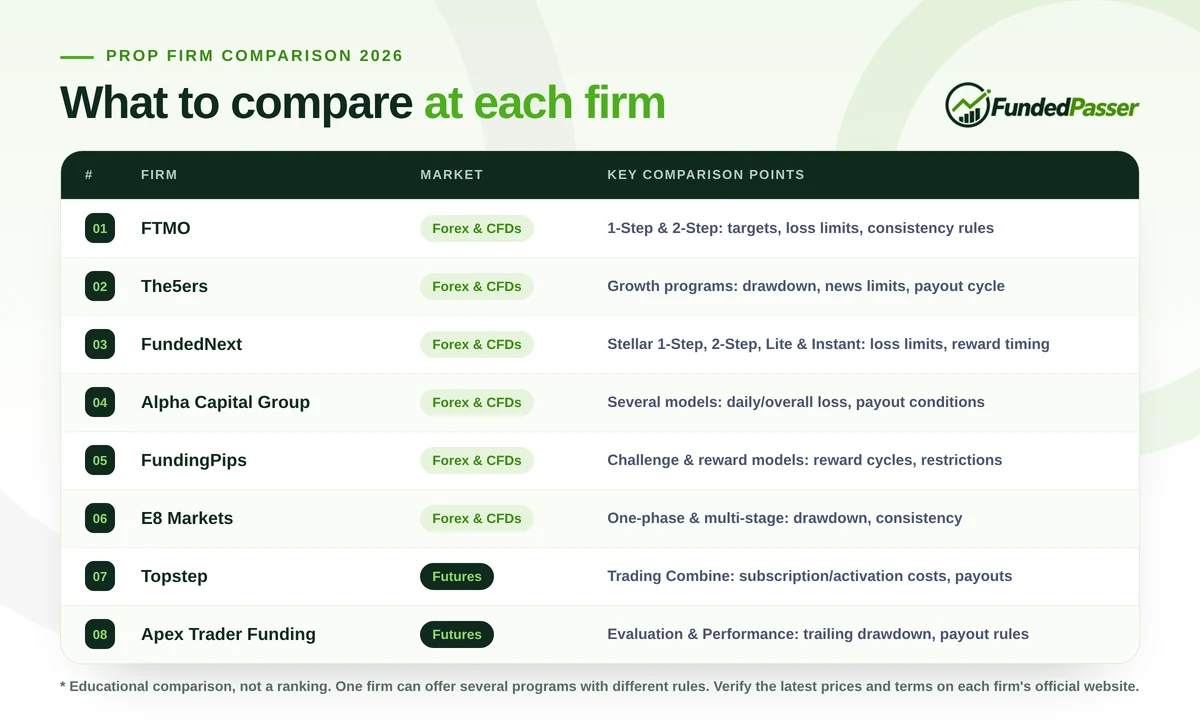
Prop Firm Comparison Table
|
Prop Firms |
Market / Program |
Key comparison points |
|
FTMO |
Forex & CFDs |
1-Step and 2-Step evaluations; targets, loss limits and consistency rules |
|
The5ers |
Forex & CFDs |
Multiple growth programs; drawdown, news execution limits and payout cycle |
|
FundedNext |
Forex & CFDs |
Stellar 1-Step, 2-Step, Lite and Instant; loss limits and reward timing |
|
Alpha Capital Group |
Forex & CFDs |
Different evaluation models; daily/overall loss and payout conditions |
|
FundingPips |
Forex & CFDs |
Multiple challenge and reward models; reward cycles and restrictions |
|
E8 Markets |
Forex & CFDs |
One-phase and multi-stage products; drawdown and consistency |
|
Topstep |
Futures |
Trading Combine; subscription/activation costs and payout conditions |
| Apex Trader Funding |
Futures |
Evaluation and Performance Accounts; trailing drawdown and payout rules |
The table is a starting point, not a substitute for checking the exact account model. One firm can offer several programs with different rules.
1. Compare the Total Cost, Not Just the Advertised Fee
A challenge fee may be only one part of the cost. Check whether the account uses a one-time payment or a subscription, whether an activation fee is charged after passing, and what resets, add-ons or platform charges may apply. Topstep publishes different monthly Trading Combine prices for its Standard and No Activation Fee paths. Apex describes its evaluation purchase as a one-time fee with a 30-calendar-day access period. These are different payment models, so compare the total cost over the time you realistically expect to need.
2. Understand Daily and Maximum Drawdown
Drawdown is one of the most important parts of any prop firm comparison. A daily loss limit may reset at a set time, while an overall limit may be static or trailing. Some firms calculate limits using balance, equity or the higher of the two. A trailing threshold can move as the account reaches new highs, changing how much room you have to manage open positions. Read the exact calculation method—not just the percentage shown in an advertisement.
3. Check Evaluation Targets and Time Limits
Some programs use a two-step evaluation, others use one phase, and some offer instant or no-evaluation models. Compare the target for each phase, minimum trading days, time limits and any consistency requirement. A lower target does not automatically make a program easier if the drawdown limit is tighter or payout rules are more demanding.
4. Compare Profit Split and Payout Conditions
Do not compare profit splits in isolation. Check when the first payout becomes available, the minimum withdrawal, payout caps, required winning days, consistency rules and any buffer that must remain in the account. Topstep’s payout policy sets conditions for Express Funded and Live Funded accounts. FundedNext’s Stellar 2-Step page lists a 21-day first reward eligibility period and subsequent bi-weekly rewards for that specific model. Terms can differ across other programs.
5. Review Trading Rules Before You Buy
A strategy allowed in one program may be restricted in another. Check rules for high-impact news, weekend holding, expert advisors, copy trading, account sharing, inactivity, lot size and prohibited trading practices. Also confirm whether the account is simulated or live and how performance rewards are calculated.
Forex/CFD vs Futures Prop Firms
FTMO, The5ers, FundedNext, Alpha Capital Group, FundingPips and E8 Markets are commonly compared for Forex/CFD-style programs. Topstep and Apex Trader Funding focus on futures. Futures programs may use contract limits, exchange-session rules and different drawdown or payout mechanics. If you trade futures, compare futures firms with each other; if you trade Forex or CFDs, focus on programs that support those instruments.
How to Choose the Right Prop Firm
- Choose a firm that supports your preferred market, instruments and trading platform.
- Calculate the full cost, including subscription, activation, reset and optional add-on fees.
- Understand whether drawdown is static, balance-based, equity-based or trailing.
- Check payout schedule, minimum withdrawal, caps and consistency conditions.
- Read rules for news, weekend trades, EAs, copy trading and third-party account access.
- Save a copy of the terms that apply to your exact account and purchase date.
Need Help with a Prop Firm Challenge?
Once you have compared the firms and selected a suitable program, the next step is to prepare for its evaluation rules. FundedPasser offers a Prop Firm Passing Service for traders who want to learn about the service, process and available support. Before using any third-party trading or account-management service, confirm that the selected firm and account agreement explicitly permit the arrangement. Some firms restrict account sharing, external execution or third-party access.
Learn more about the Prop Firm Passing Service and check whether the service is compatible with your chosen firm’s rules.
Final Thoughts
The best prop firm is not necessarily the cheapest or the one advertising the highest profit split. Compare the complete rulebook, payment structure, drawdown calculation and payout requirements for the exact program you plan to purchase. A careful comparison can help you avoid choosing an account whose conditions do not fit your trading style.