


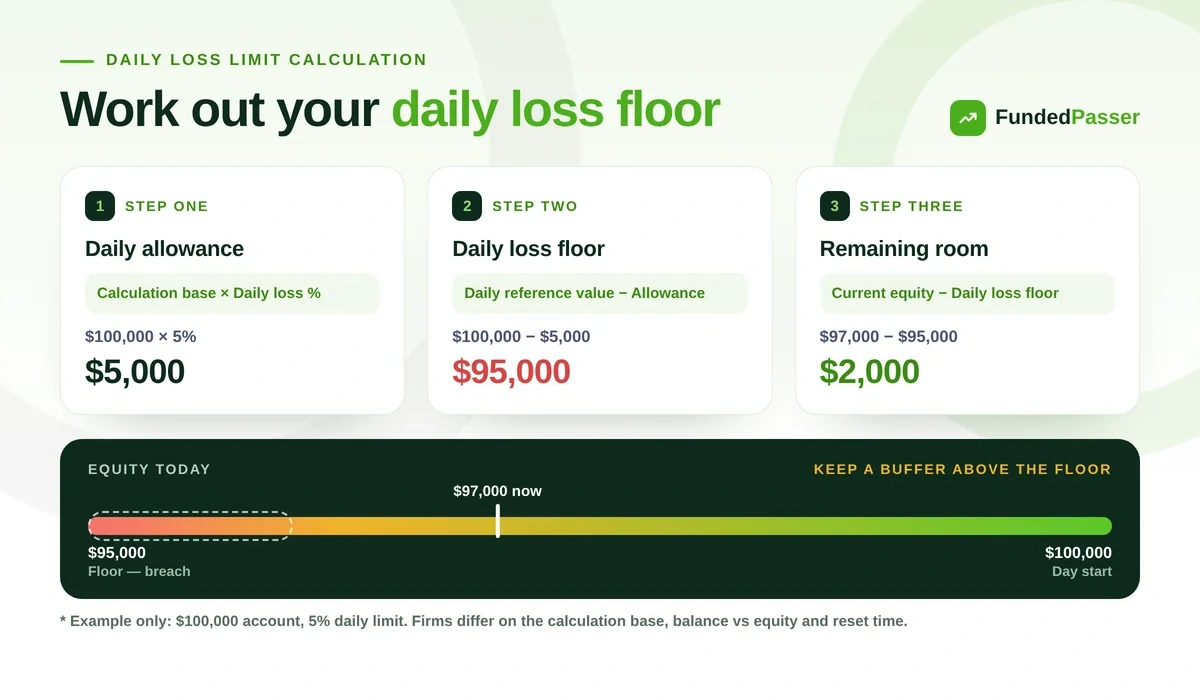
A daily loss limit in prop firm sets the maximum amount your account can lose in one trading day. Crossing it may fail your challenge, even when you are close to the profit target.
The percentage in your account rules is only the starting point. You also need to understand the calculation base, open trades, charges, and daily reset time.
This guide explains the calculation with simple examples.
1. What Is a Daily Loss Limit?
A daily loss limit caps how much an account can lose in one trading day. It helps prevent large losses in a short period.
For example, a firm may set a 5% daily limit on a $100,000 challenge. The calculation base might be the initial balance, the day-start balance, or a defined balance/equity figure. It depends on the firm and account type.
2. The Basic Daily Loss Limit Formula
| Basic formula
Daily loss allowance = Calculation base × Daily loss percentage |
Use the calculation base stated in the firm’s rules. Do not assume it is always the initial balance.
3. Example: A $100,000 Account With a 5% Limit
Suppose the firm calculates a 5% daily allowance from a $100,000 initial balance:
|
Initial account balance |
$100,000 |
|
Daily loss percentage |
5% |
|
Daily loss allowance |
$100,000 × 0.05 = $5,000 |
| First-day equity floor |
$100,000 − $5,000 = $95,000 |
In this example, equity must stay above $95,000. Other calculation methods can produce a different floor.
4. Why the Daily Reset Time Matters
Firms reset the daily calculation at a set time. It may follow server time, market time, or UTC, so do not assume it resets at your local midnight.
Check the reset time zone, especially when holding trades overnight. Open positions may affect the next day’s calculation, depending on the prop firm’s rules.
5. Does the Firm Use Balance or Equity?
Balance reflects closed trades and charges. Equity also includes the current profit or loss on open positions.
If a firm checks live equity, an open losing trade can breach the limit before you close it.
Check whether commissions, swaps, and other trading costs count. They can matter when you are close to the limit.
6. How to Calculate Your Remaining Daily Loss Room
For an equity-based rule, estimate your remaining room like this:
| Remaining room
Remaining daily loss room = Current equity − Daily loss floor |
If the floor is $95,000 and current equity is $97,000, the remaining room is $2,000. Leave a buffer for price movement, spreads, commissions, and slippage rather than trading up to the limit.
7. Daily Loss Limit vs Maximum Loss Limit
They serve different purposes:
- Daily loss limit: controls how much the account can lose during one trading day. It normally resets according to the firm’s schedule.
- Maximum loss limit: sets the lowest point the account can reach over the full challenge or account period. It may be static or trailing.
Monitor both. Staying within the daily limit does not protect you from breaching the maximum loss rule.
8. Common Mistakes to Avoid
- Calculating the limit from the initial balance when the firm uses a daily starting balance or equity.
- Watching closed-trade balance but ignoring floating losses on open positions.
- Forgetting that commissions and swaps may count toward the loss limit.
- Using your local midnight instead of the firm’s stated reset time.
- Trading right up to the limit without leaving a buffer.
9. Daily Loss Limit Checklist
Before trading, check:
- What percentage is my daily loss limit?
- What amount is used as the calculation base?
- Is the rule based on balance, equity, or both?
- When does the daily limit reset, and in which time zone?
- Do floating losses, commissions, and swaps count?
- What is my personal stop-trading point below the firm’s limit?
Frequently Asked Questions
Can I risk the full daily loss limit on one trade?
It may fit the calculation, but it is risky. One fast market move could breach the account.
Do open trades count?
They may count when the firm checks equity or floating profit and loss. Confirm your account’s rule.
Does the daily loss limit reset every 24 hours?
It resets on the firm’s schedule. The time zone can vary, so check the account rules.
Is it the same as maximum drawdown?
No. The daily limit applies to one day; maximum drawdown applies over the full account period.
Final Thoughts
The calculation becomes easier when you know the percentage, base amount, and reset time. The key is understanding how your firm measures losses, including open trades.
Read the rules, monitor equity when required, and leave a buffer. A clear risk plan can help you avoid preventable mistakes.