


Prop trading firms, also known as proprietary trading firms, give traders a way to demonstrate their skills through a structured trading programme. Many online firms invite traders to complete an evaluation, follow specific risk limits, and qualify for a funded or profit-sharing account. The exact arrangement can differ from one firm to another, so understanding the model is just as important as having a trading strategy.
What Are Prop Trading Firms?
In traditional finance, a proprietary trading firm uses its own capital to trade financial markets. Many online prop firms use a different model: traders usually purchase an evaluation or enter a qualification programme and are assessed against targets and risk rules. Those who meet the requirements may move to a funded stage under the firm’s agreement.
The phrase “funded account” does not mean every programme works in the same way. Some firms use simulated trading environments, while others may operate different capital or execution arrangements. Read the programme description and contract carefully rather than assuming that all firms provide the same type of account.
How Do Prop Trading Firms Work?
Although the details vary, the process commonly follows these stages:
- Choose a programme: Compare the firm, account size, evaluation fee, trading platform, profit target, drawdown limits, and payout conditions.
- Complete the evaluation: Trade according to the programme rules. You may need to reach a profit target without exceeding daily or maximum drawdown limits, and some programmes also set minimum trading-day or consistency requirements.
- Complete verification: After meeting the evaluation conditions, the firm may request identity checks or other documents and ask you to accept a funded-stage agreement.
- Trade the funded stage: Continue following the rules that apply to the next stage. These may differ from the evaluation rules, particularly around news events, holding positions overnight, or payout eligibility.
- Request a payout: A payout is subject to the firm’s agreement, verification process, trading conditions, and any applicable review. Passing an evaluation does not guarantee a payout.
Common Types of Prop Firm Programmes
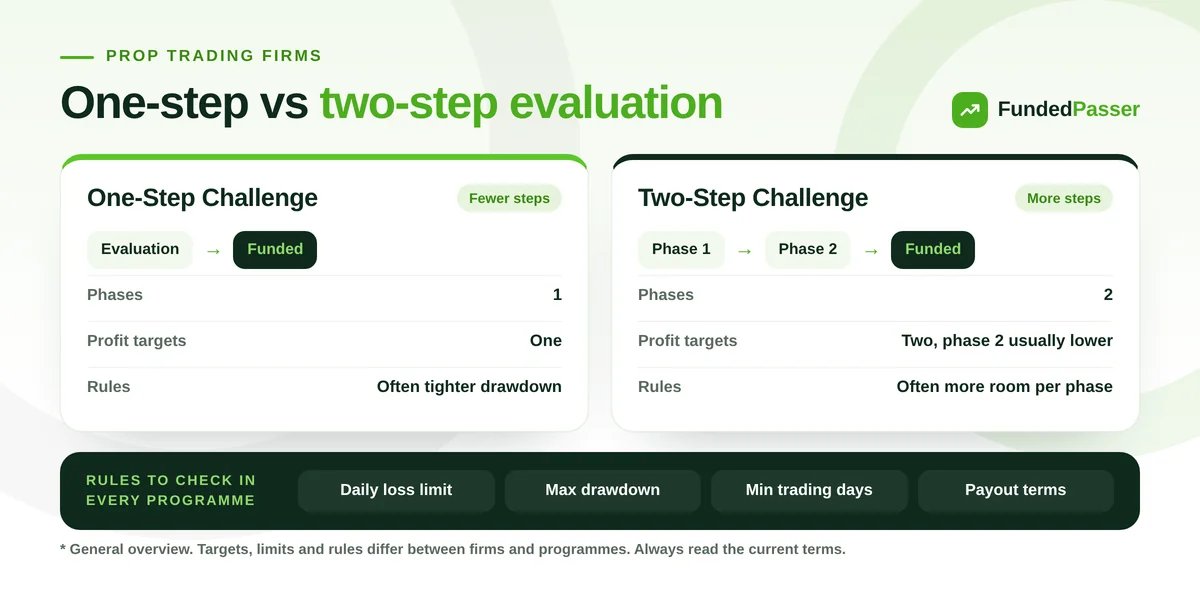
A one-step challenge generally has one evaluation stage before the funded stage. A two-step challenge uses two evaluation phases, often with different targets or conditions. Instant-funding programmes may provide access to a trading account without the usual multi-stage evaluation, but they can have different fees, limits, and restrictions. Compare the full terms, not only the advertised profit target or account size.
Important Prop Firm Rules to Understand
Before paying for a challenge, read the current rules and make sure you can follow them. Pay particular attention to:
- Profit target and minimum trading days: Know what counts toward the target and whether there is a time limit.
- Daily loss and maximum drawdown: Check how losses are calculated, when the daily limit resets, and whether open trades, commissions, or swaps are included.
- Trading restrictions: Review rules for news trading, weekend positions, copy trading, expert advisors, prohibited strategies, and consistency requirements.
- Account access and third-party trading: Some firms restrict or prohibit another person from accessing or trading an account. Never assume that account sharing or outside trade execution is allowed; obtain clear confirmation from the firm before proceeding.
- Payout conditions: Check minimum profitable days, profit splits, withdrawal schedules, identity checks, and reasons a payout can be withheld.
How to Choose a Prop Trading Firm
A suitable firm is not necessarily the one advertising the largest account. Look for clearly written rules, transparent fees, realistic conditions, accessible customer support, and a straightforward payout policy. Check the legal entity named in the agreement and understand the firm’s dispute and refund terms. Search for independent feedback, but do not rely only on testimonials or social media screenshots.
Most importantly, choose a programme that matches your experience and risk tolerance. A lower evaluation fee is not useful if the rules are difficult for you to meet or the potential loss of the fee would cause financial pressure. If you’re stuck on passing a prop firm challenge contact us.
How Traders Can Prepare for an Evaluation
Build a repeatable plan before starting. Practise the strategy on a demo account, decide your risk per trade, set a daily stop limit below the firm’s maximum, and keep a trading journal. Avoid increasing position size to recover a loss or rushing to reach a target. If market conditions are unclear, protecting the account by staying out of the market can be a valid decision.
Getting Support With a Prop Firm Challenge
Some traders prefer to prepare independently, while others look for education or professional assistance. FundedPasser explains its Prop Firm Passing Service for traders comparing challenge-support options. Before using any service that involves another person accessing or placing trades on your account, check the specific prop firm’s current terms and get written confirmation that the arrangement is permitted. If third-party access or trading is not allowed, do not share your login or use that arrangement.
Frequently Asked Questions
Are all prop trading firms the same?
No. Evaluation stages, fees, drawdown calculations, trading restrictions, account structures, and payout terms can vary significantly.
Does passing a challenge guarantee a payout?
No. Traders must continue to meet the funded-stage rules and complete any required verification. Payouts remain subject to the firm’s agreement and review.
Can another person trade my prop firm account?
It depends on the firm and programme. Some restrict or prohibit third-party trading or account sharing. Check the current written terms and obtain confirmation before allowing anyone else to access the account.
Final Thoughts
Prop trading firms can offer a structured way for traders to demonstrate their skills, but every opportunity comes with conditions. Compare the programme carefully, understand the risk limits, and make sure you can follow the rules before paying an evaluation fee. A disciplined process and a clear understanding of the agreement are more valuable than chasing a large account or a quick result.